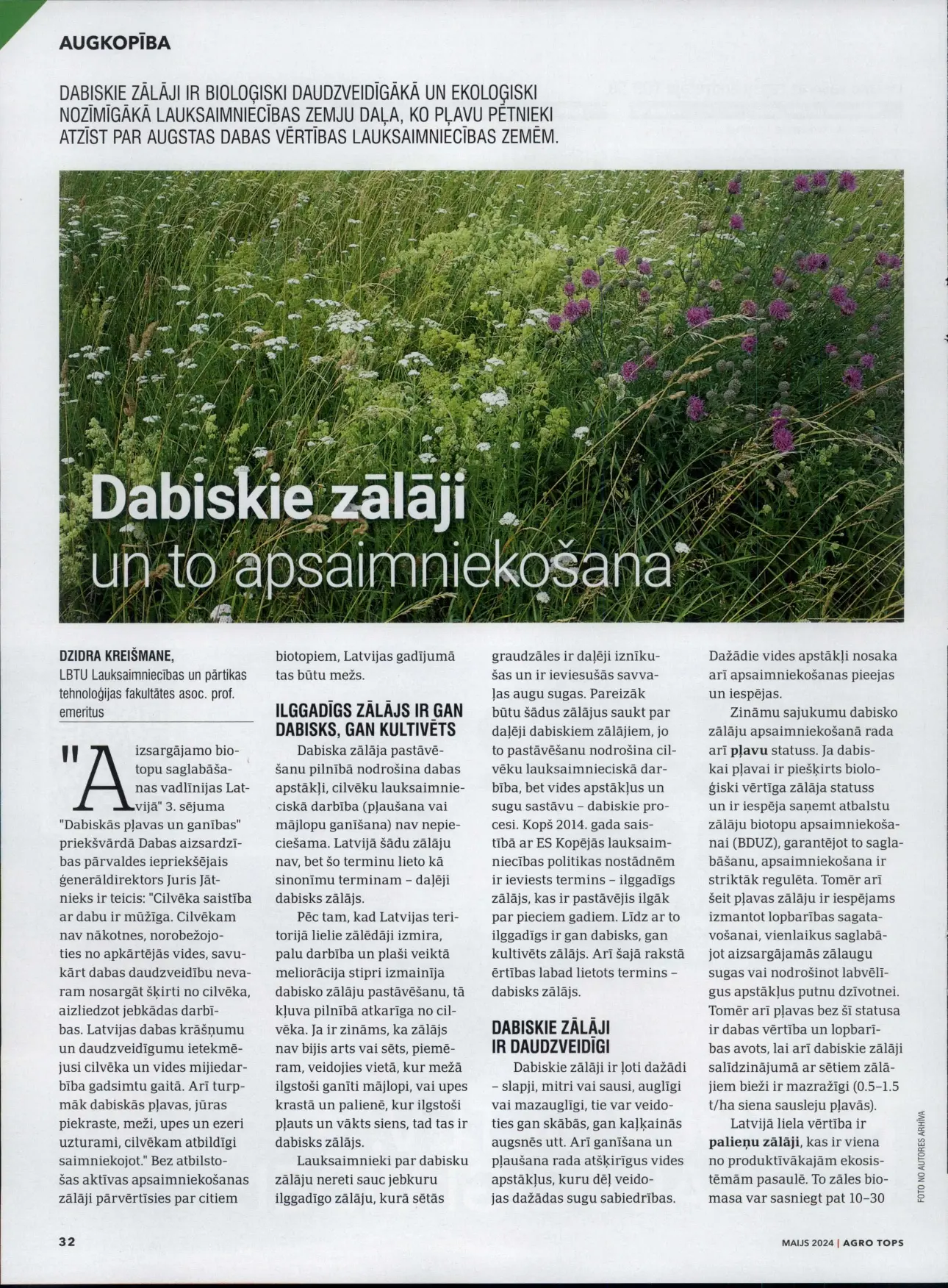
DZIDRA KREIŠMANE, Associate Professor Emeritus at the Faculty of Agriculture and Food Technology, LBTU
The existence of a natural grassland is entirely sustained by natural conditions; human agricultural activity (mowing or livestock grazing) is not required. There are no such grasslands in Latvia, but the term is used as a synonym for ‘semi-natural grassland’.
Following the extinction of large herbivores in Latvia, the effects of spring floods and widespread land drainage significantly altered the natural state of grasslands, making them entirely dependent on human activity. If it is known that a grassland has not been ploughed or sown, for example, having formed in a place where livestock were grazed in the forest over a long period, or on a riverbank and in a floodplain where hay was mown and harvested over a long period, then it is a natural grassland.
Farmers often refer to any perennial grassland as ‘natural grassland’ where the sown cereal crops have partially died off and wild plant species have become established. It would be more accurate to refer to such grasslands as semi-natural grasslands, as their existence is sustained by human agricultural activity, whilst the environmental conditions and species composition are determined by natural processes. Since 2014, in line with the EU’s Common Agricultural Policy guidelines, the term ‘permanent grassland’ has been introduced to refer to grassland that has existed for more than five years. Consequently, both natural and cultivated grassland are considered permanent. For the sake of convenience, this article also uses the term ‘natural grassland’.
NATURAL GRASSLANDS ARE DIVERSE
Natural grasslands are extremely diverse – wet, damp or dry, fertile or poor in nutrients; they can develop in both acidic and calcareous soils, and so on. Grazing and mowing also create different environmental conditions, leading to the formation of diverse species communities. These varying environmental conditions also determine management approaches and options.
The status of a meadow also causes some confusion in the management of natural grasslands. If a natural meadow has been granted the status of a biologically valuable grassland and is eligible for support for the management of grassland habitats (BDUZ), thereby ensuring its conservation, its management is more strictly regulated. However, even in such cases, it is possible to use the meadow grassland for fodder production whilst preserving protected grassland species or ensuring favourable conditions for bird habitats. Nevertheless, even meadows without this status are of natural value and a source of fodder, although natural grasslands are often less productive than cultivated grasslands (0.5–1.5 t/ha of dry hay in hay meadows).
Floodplain grasslands are of great value in Latvia, as they are among the most productive ecosystems in the world. Their grass biomass can reach as much as 10–30 t/ha of green matter or 2–5 t/ha of hay. In some regions of Latvia, floodplain grasslands still have very high economic value, as they cover large areas and, because agrotechnical conditions make it impossible to cultivate arable land there, only livestock farming can be practised there.
Even natural meadows in wetter areas – not just floodplains – can yield a fairly good grass harvest, rich in minerals and vitamins. The diversity of plant species often found in such grasslands promotes feed intake and digestibility. This is, however, on condition that the grass is mown or grazed at an early stage of growth – overgrown grass will only be of value as bedding.
Read the full article here: Natural Grasslands and Their Management_Dz. Kreišmane_LBTU_AgroTops_05.2024