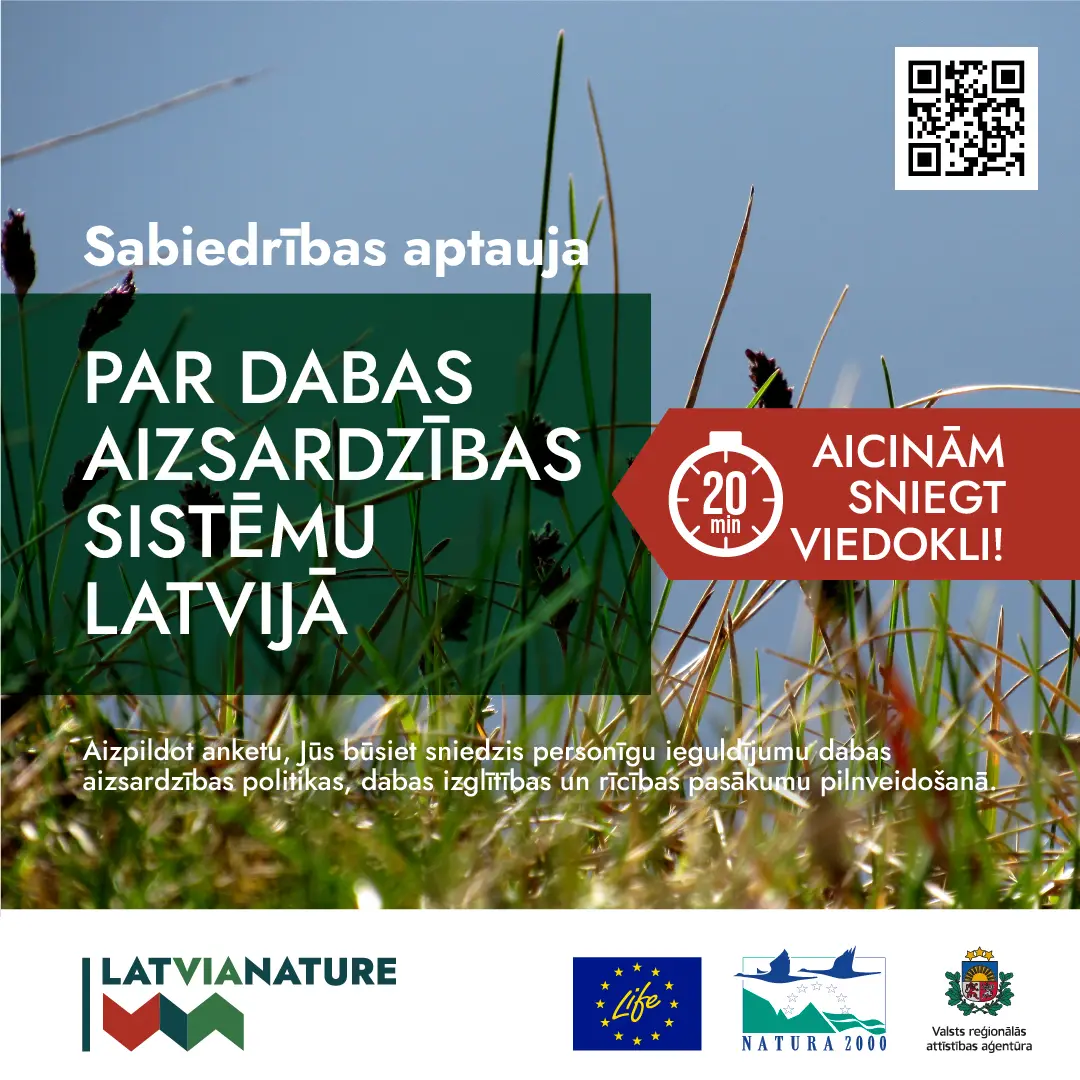
As part of the LatViaNature project, the Nature Conservation Agency is inviting members of the public to take part in a public survey by 31 October, to gauge attitudes, knowledge and understanding regarding the conservation of biodiversity and nature conservation in Latvia, as well as key information about recreation and travel in the countryside. You can take part in the survey online, and its results will be used to improve nature conservation policy, nature management and nature education.
You can complete the survey online until 31 October here: https://ej.uz/sab_aptauja. The survey is anonymous and will take approximately 15–20 minutes to complete. All the information gathered will be used solely in aggregated form and will provide researchers with valuable data. The conduct of the survey, as well as the compilation and analysis of the results, will be carried out by one of the partners in the LatViaNature project – Vidzeme University of Applied Sciences.
“Nature is a value shared by the whole of society, ensuring a sustainable future, human well-being and a healthy economy. Its conservation and protection are in our common interest. Given that Latvia’s nature conservation system has historically developed in stages and in a piecemeal fashion, there is scope for improvement as well as opportunities for development. Public opinion enables us to move towards a nature conservation system in Latvia that is well-functioning, scientifically sound, stable and understandable, so I urge everyone to take part in the survey,” says Andris Širovs, Acting Director-General of the Nature Conservation Agency.
From 1 September to 31 October, face-to-face surveys will be conducted in parallel, specifically targeting the necessary sections of the public to ensure that the survey results reflect the views of society as a whole. The survey data will be collated by April 2025, with publication of the data scheduled for June next year.
The results of the survey will be passed on to those responsible for shaping the country’s nature conservation policy and will be used to plan and take action more effectively to preserve natural assets, including through management and public education.
The survey is being carried out as part of the LatViaNature LIFE integrated project, implemented by the Nature Conservation Agency. As part of the project, public opinion will be gauged on three occasions – in 2021, 2024 and 2028. The results of the first public survey are available here: https://ej.uz/dabas_aizsardzibas_aptauja_I.
Unlike the survey conducted at the start of the project, this year, alongside the survey of Latvian residents, a survey of foreign tourists is also being carried out, with the aim of finding out about their experiences whilst holidaying in Latvia and travelling in the countryside. The questionnaire for foreign tourists is available here: https://ej.uz/tourists_EN. “We invite you to share this survey with your friends, acquaintances and colleagues from abroad who have visited Latvia and travelled outside the cities over the past year,” says Andris Širovs.
Vidzeme University of Applied Sciences, which is conducting this survey, has gained experience by carrying out surveys both as part of national research programme projects and international projects, and by conducting surveys of the general public and businesspeople in Latvia.
The survey is being carried out as part of the project “Optimisation of the Management and Stewardship of Natura 2000 Protected Areas” (LIFE19IPE/LV/000010, LIFE-IP LatViaNature), which is being implemented with financial support from the European Union’s LIFE Programme and the State Regional Development Agency.