Anita Siliņa, Head of the LLKC Livestock Farming Competence Centre, “Latvijas Lopkopis”, January 2025
In beef cattle farming, proper pasture management – moving cattle between grazing areas and improving grazing practices – plays a key role. This can promote grass productivity, the efficiency of pasture use, and the health and productivity of grazing cattle.
“More than 60 % of the European Union’s soil is in poor condition and requires fertility restoration,” said a seminar on sustainable livestock farming practices organised in December by Latvian Nature Fund In collaboration with the “Latvijas liellops” agricultural cooperative, said Airi Kulveta, a farmer from Puutsa Farm, located in the village of Terves in Peltsama parish, and is a member of “Liivimaa Lihaveis”, Estonia’s largest beef cattle breeders’ co-operative. She was invited to share her experience and knowledge of beef cattle farming, farming on 300 ha and rearing 170 head of beef cattle of the Angus, Hereford, Simmental and Wagyu breeds.
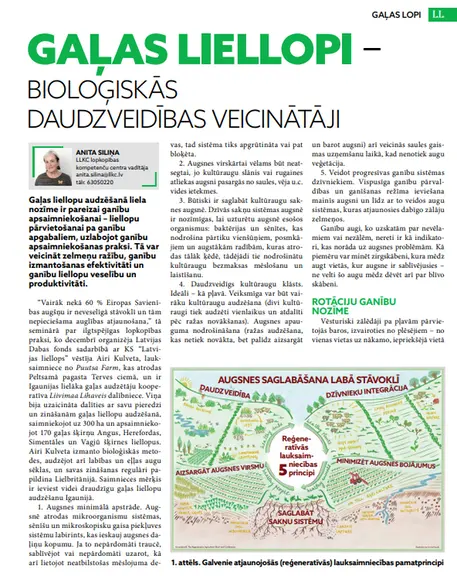
1. Minimum tillage. The soil contains a network of microorganisms, fungi and a labyrinth of microscopic air channels that surround the soil particles. If this is carelessly disturbed – through compaction or thoughtless tillage, as well as the use of inappropriate fertiliser doses – the system will be impeded or even blocked.
2. It is preferable for the topsoil to remain uncovered, as the crop layer or stubble will protect the soil from the sun, wind and other environmental factors.
3. It is essential to keep crop roots in the soil. Living root systems in the soil are vital for sustaining the organisms present there: bacteria and fungi, which provide food for single-celled organisms, insects and higher organisms further up the food chain, thereby providing free fertilisation and irrigation for the crops.
4. A diverse range of crops. Ideally – like in a meadow. Growing several crops simultaneously can be successful (two crops are grown at the same time and separated after harvest). Ensuring soil cover (growing crops that are not harvested but help to protect and nourish the soil) will also promote sunlight uptake during periods when plants are not growing.
5. To develop progressive grazing systems for livestock. The introduction of a comprehensive grazing management and grazing regime will transform the soil and, as a result, create plant communities that will regenerate in natural grassland habitats.
Pasture plants that we regard as undesirable or weeds are often indicators of soil problems. One example is horse sorrel, which tends to grow in places where the soil is compacted – it is no coincidence that this plant is also known as ‘compacted sorrel’.
THE IMPORTANCE OF ROTATIONAL GRAZING
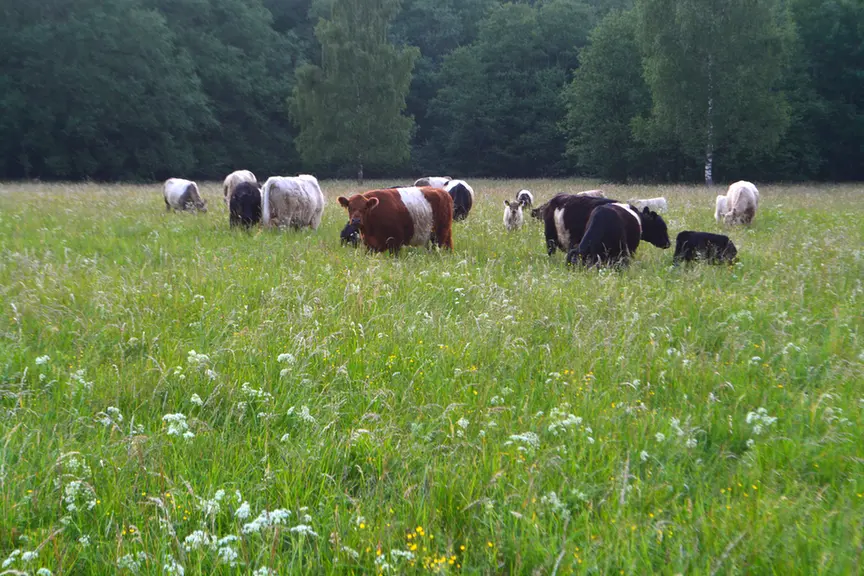
Historically, herbivores moved across meadows in herds, avoiding predators – moving from one place to the next, and returning to the previous spot after a longer period of time. This instinct has developed genetically in herbivores as a means of evading predators. When cattle are grazed in one spot for a short period, the vegetation has a chance to recover, whilst intensive grazing over a short period has a positive effect on both the plant species growing in the pasture sward and the species coexisting alongside them. Grazing for a longer period in one place leads to a deterioration in the botanical composition of the sward, a reduction in pasture productivity, and the sward is unable to recover quickly after grazing. In contrast to the traditional grazing system, where grazing takes place for a long time in a single field, rotational grazing involves grazing the field gradually, dividing the grazing area into small parcels or paddocks. Research findings show that, by adopting rotational grazing, grass yield can be increased by 15–45 % compared with traditional grazing, whilst the quality of the grass is also improved.
THE BENEFITS OF PLANNED GRAZING
In grasses, the root system continues to grow if 50 % of the plant is grazed, but if 70 % of the plant is grazed, then after 17 days the root systems of the 50 % plants continue to grow; when 90 % is grazed – 100 % of the roots ceases to grow for 17 days (see Figure 2).
In a rotational grazing area: 50–60 % plants are grazed, 30 % are trampled, and 20–10 % plants remain untouched. Rotational grazing means grazing on a single pasture plot for no more than 1–3 days, after which the pasture area recovers – regrows – over 30 days. If animals graze plants to a height of less than 5 cm above the ground, not only will the sward regrow more slowly, but the animals will also be exposed to the risk of parasites, as the parasites found in pastures are located in the parts of the plants closest to the ground. Plants grazed down to less than 5 cm will have very limited regrowth potential. Similarly, when mowing roughage, the cut should not be made lower than 10 cm.
FEEDING CATTLE DURING THE WINTER MONTHS
It is important to feed cattle roughage whilst they are grazing during periods when the grass is not growing. Continuing to supplement cattle’s diet with roughage on pasture during periods when the amount of grass cover decreases helps to restore soil health; experts cite this as a good solution for reducing moss growth on pasture. Nutrients are returned to the soil in their most beneficial form, and nitrogen losses are prevented. The soil also requires animal hair, manure and saliva.
CATTLE HEALTH
Cattle eat better if they can graze on the ground – that is their natural way of feeding.
When unrolling the bales, ensure there is sufficient space. The feed should be unrolled in a different spot each day so that the animals do not trample it, but instead move evenly across the pasture areas as they graze. The more the cattle move about, the more positive the effect on udder health and the calving process. Cattle need to be able to lie down in a clean and dry place; they must not lie in mud or manure. Cattle’s coats must be clean; they may occasionally be damp, but must not be muddy or soiled with manure.
THE IMPACT OF WINTER GRAZING
Studies have shown that rotational grazing can have a positive impact on the micro-water cycle by improving soil structure and increasing the soil’s water-holding capacity (Teague et al., 2016).
Rotational grazing improves the soil’s organic matter content and reduces soil erosion, whilst increasing the availability of water to plants. This was particularly evident in 2023, when there was a severe drought.
There are many benefits to using a patch, rotation or precision grazing system in beef cattle farming, but the key point to bear in mind is that the grazing system or electric fence must be moved regularly every 1–3 days. In a herd of cattle, all animals must have equally good access to the feed line (for winter feed) or the grassy area (during the growing season); there must be no competition amongst them for the best spot at the feed line, or at the watering point; however, this means that the herd must not be too large.
The most suitable breeds for a year-round grazing system are British breeds:
Aberdeen Angus, Hereford, Highland and Galloway breeds. British-type breeds are primarily bred for use as grass-fed livestock, having adapted to harsher weather conditions, and thus for meat production in a more extensive manner, yielding moderately muscled carcasses. Here in Latvia, too, the number of farms choosing to rear Aberdeen Angus beef cattle is increasing year on year.
For this system to function effectively, it is important for the farmer to manage and organise the herd’s grazing carefully, taking into account the location and geographical characteristics of the pasture parcels.
Article with illustrations here: Galas_liellopi_biolog.daudzveidibas_veicinataji_Latv.Lopkopis_01%202025.pdf