Latvian Livestock Farmer 12/2024, Inga Muižniece, Latvian Nature Fund.
In light of the European Green Deal policy, the agricultural sector as a whole is set to undergo significant changes in the future. The climate is changing, the prices of all kinds of production resources are rising, and there is a push towards renewable resources. There will be an increasing demand for environmentally and nature-friendly solutions in the field of food production.
Natural grasslands – a threatened habitat
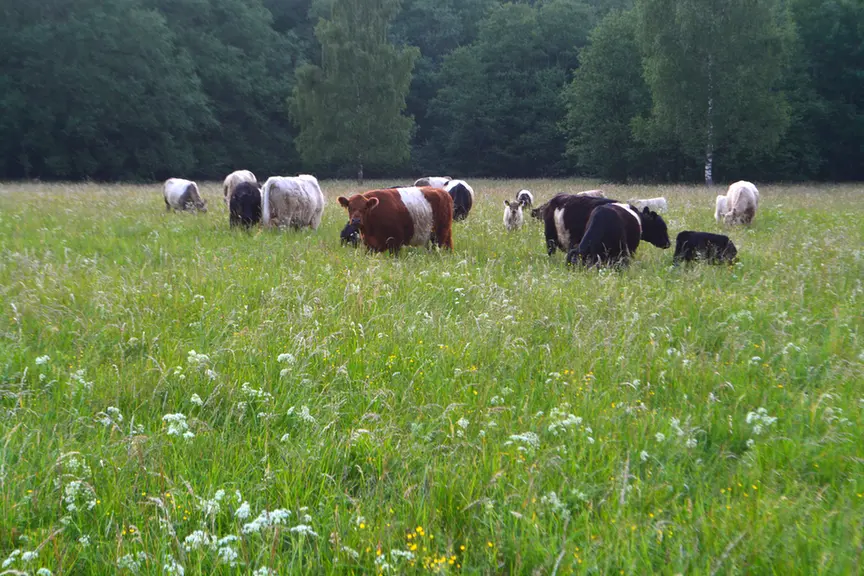
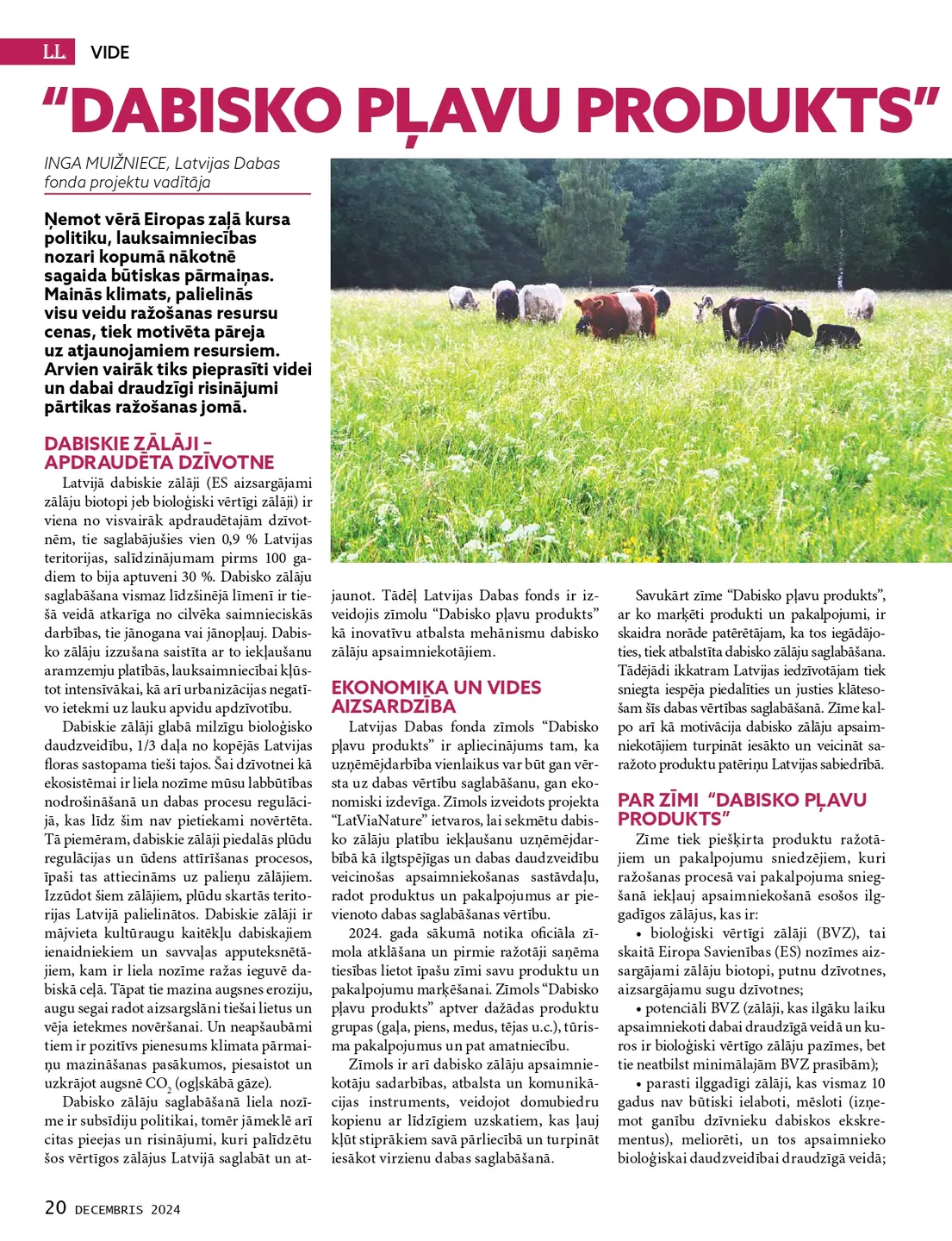
In Latvia, natural grasslands (EU-protected grassland habitats or biologically valuable grasslands) are one of the most threatened habitats; they now cover just 0.9% of Latvia’s territory; by comparison, 100 years ago they covered approximately 30%. The conservation of natural grasslands at least at their current level is directly dependent on human economic activity; they must be grazed or mown. The disappearance of natural grasslands is linked to their conversion into arable land as farming becomes more intensive, as well as to the negative impact of urbanisation on rural settlement patterns.
Natural grasslands harbour a vast amount of biodiversity; one-third of Latvia’s total flora is found there. As an ecosystem, this habitat plays a vital role in ensuring our well-being and regulating natural processes, a role which has not yet been sufficiently recognised. For example, natural grasslands play a role in flood regulation and water purification, particularly floodplain grasslands. If these grasslands were to disappear, the areas affected by flooding in Latvia would increase. Natural grasslands provide a habitat for the natural enemies of crop pests and wild pollinators, which play a significant role in ensuring harvests through natural means. They also reduce soil erosion by providing a protective layer of vegetation that shields the soil from the direct impact of rain and wind. And there is no doubt that they make a positive contribution to climate change mitigation by sequestering and storing CO₂ (carbon dioxide) in the soil.
Subsidy policy plays a major role in the conservation of natural grasslands; however, other approaches and solutions must also be sought to help preserve and restore these valuable grasslands in Latvia. For this reason, the Latvian Nature Fund has created the “Natural Grassland Product” brand as an innovative support mechanism for natural grassland managers.
Business that combines economic considerations with the protection of nature and the environment
The Latvian Nature Fund’s “Natural Meadow Product” label is proof that business can be both focused on preserving natural values and economically viable. The brand was created as part of the “LatViaNature” project to promote the integration of natural grassland areas into business as a component of sustainable management that fosters biodiversity, thereby creating products and services with added value in terms of nature conservation.
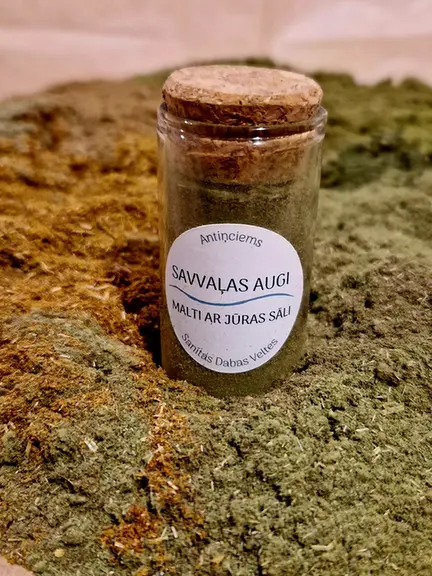
In early 2024, the brand was officially launched and the first producers were granted the right to use a special mark to label their products and services. The “Natural Meadow Product” brand covers various product groups (meat, milk, honey, teas, etc.), tourism services and even handicrafts.
The brand also serves as a tool for cooperation, support and communication, creating a community of like-minded people who share similar views, enabling them to become stronger in their convictions and to continue on the path towards nature conservation.
The “Natural Meadow Product” label, which is used to mark products and services, serves as a clear indication to consumers that, by purchasing them, they are supporting the conservation of natural grasslands. In this way, every resident of Latvia is given the opportunity to participate and feel involved in the conservation of this natural asset. The label also serves as an incentive for natural grassland managers to continue their work and to promote the consumption of the products they produce amongst the Latvian public.
About the “Natural Meadow Product” label”
The label is awarded to product manufacturers and service providers who incorporate managed permanent grassland into their production processes or service provision; such grassland must be:
- biologically valuable grasslands (BVZ), including grassland habitats of European Union (EU) importance, bird habitats and habitats of protected species;
- potential BVZ (grasslands that have been managed in an environmentally friendly manner for a prolonged period and exhibit characteristics of biologically valuable grasslands, but do not meet the minimum BVZ requirements);
- typically permanent grasslands that have not been significantly improved, fertilised (with the exception of natural manure from grazing livestock), or drained for at least 10 years, and which are managed in a way that promotes biodiversity;
- grasslands where targeted naturalisation is being carried out (including mechanical treatment and the sowing of grasses), in accordance with a grassland restoration plan approved by the Nature Conservation Agency.
The area of the BVZ must account for at least 0.3 ha of the total managed area.
Products and services must be labelled with the mark and must be made available to the people of Latvia.
To apply for the right to use the mark, you must complete the application form on the brand’s website: https://dabiskoplavuprodukts.lv/pievienojies-mums. Once the application has been received, the eligibility assessment process begins. The compliance assessment takes place in two stages: in the first stage, compliance with the conditions is assessed on the basis of the information provided in the application and the accompanying documents. If the decision is positive, the second stage of the assessment follows, which involves an on-site assessment of the conditions. The on-site assessment takes place between April and October.
The conditions cover various product categories; in this instance, they relate specifically to livestock products.
Meat and milk from the meadows
The criteria for the “Natural Meadow Product” label have been drawn up with the aim of promoting livestock farming practices that are friendly to nature, the environment and animals. There is much discussion about the negative impact of ruminants, particularly cattle, on climate change; unfortunately, in this context, the diversity of livestock farming practices and their varying impacts on the climate and the environment are not taken into account. Animal welfare is also a key consideration, and this varies depending on the chosen level of production intensity.
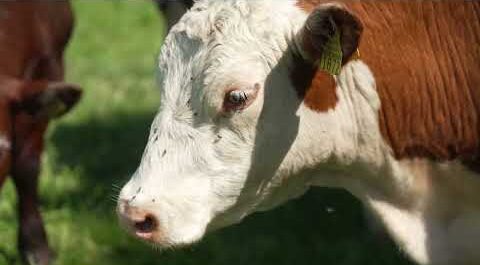
The “Natural Meadow Product” brand supports livestock farming practices based on the use of grass forage in livestock production, grazing animals for as long as possible, and high animal welfare standards. It should be noted that beef cattle farmers have the greatest impact on the conservation of natural grasslands and their potential for restoration. However, only a relatively small quantity of produce from this sector is available on the local market, as the sector is primarily export-oriented.
The conditions for use of the label stipulate that grass fodder must account for 100% of the feed ration for animals (cattle, sheep, goats). In cases where the quality or quantity of forage is insufficient to meet the animals’ physiological needs, cereals may be included in the feed ration, but not exceeding 30% of the feed ration’s dry matter content. This provision does not apply to calves, lambs and kids of beef breeds during the suckling period, but does apply to calves of dairy breeds during the milk-feeding period.
Purchased animals must remain on the farm for at least one grazing season. This condition does not apply in cases where the animals have been purchased from a farm that has been granted the right to use the “Natural Meadow Product” label.
The use of Belgian Blue cattle or their crossbreeds for production purposes is not supported. It is stipulated that beef must be obtained from cows, heifers and steers (castrated bulls).
The strategy for livestock production must be critically assessed at both national and individual levels, for the reasons mentioned above and also in view of the competition with food production for resources such as land, water and energy. To mitigate such negative competition, the physiological ability of cattle (as well as sheep and goats), as ruminants, to process feedstuffs unsuitable for human consumption, e.g. grass fodder. In Latvia, cattle rearing – including fattening – should be promoted, whether on an extensive or moderately intensive basis, utilising our country’s renewable resources: grasslands. It is positive that Latvia enjoys a long grazing season, which is one of the measures to mitigate climate change.
A key aspect of production, regardless of the sector, is costs and the possibilities for reducing them. Livestock farmers should bear in mind that in temperate climate zones, and therefore also in Latvia, pasture grass is a considerably cheaper source of feed than feed prepared for the winter period (hay, silage) or concentrated feed. In the beef cattle sector, feed is one of the largest variable cost items, which can account for as much as 75% of the total variable cost structure and has the most direct impact on farm profitability. We must therefore make wise use of the natural resources freely available to us, whilst at the same time bearing in mind the principle of sustainable management to ensure the continued availability of these resources in the future.
Demand for beef produced in a sustainable manner, minimising negative environmental impacts and ensuring animal welfare and health, is on the rise. Consumers are opting for beef produced using organic rather than conventional farming methods, and, among organically produced products, preference is given to meat from cattle reared on grass rather than on mixed concentrates or cereals.